Wednesday, February 16, 2011
Friday, November 26, 2010
Shanti Juniors.......!
“ Every child is an artist , the problem is how to remain an Artist “ ---
- Pablo Picasso .( 1881 - 1973 )
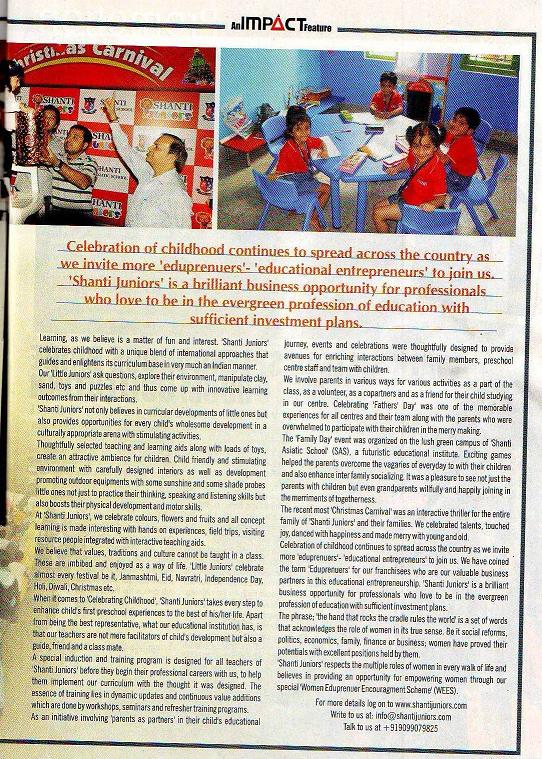
At Shanti Juniors , we celebrate childhood with fun, frolic and freedom to explore self potentials . Our children learn with hands-on and practical experiences to discover new facts about their surroundings and their skills. In a safe and secure environment, childhood colours the walls with little hands to tell a tale of their growth and development. Trained teachers are responsible stake holders who facilitates development as a guide, friend and mentor.
Play is just so important in childhood, if a child has to learn to walk, talk, read, write, think and do many more things in later stages of life. Inspired by international theories, curriculum is embellished with enjoyable learning experiences for children through play and hands-on activities. ‘Little Juniors’, begin their day with little hands holding colourful yet child friendly toys, little fingers in clay and sand feeling, playing and of course learning. Teachers tactfully teach through play, stories, songs, rhymes and games. Love and care with attractive toys, polite teachers and nature blessed environment makes ‘Shanti Juniors’ a place where children wish to be forever.
Childhood is too vast to be groomed single handed and therefore we brought together all the threads to form a ‘golden bond’ of ‘home school partnership’. Fun filled events and interactive activities are not bound the secrecy of classroom but are an important aspect of ‘parents as partners’ initiatives where we ‘celebrate childhood’ together through events like family days, father’s day, field trips, festivals etc.
We invite one and all at ‘Shanti Juniors’ to celebrate childhood with us.
“Let’s role-model for our children by practicing what we preach, let’s learn from children to play and enjoy what life has to teach.”
Monday, November 22, 2010
Our Offerings....
Our curriculum is based upon the unique I CUBE approach created by an in-house team of researchers. This curriculum shall be provided in the printed/ digital format along with audio visual and other teaching aids.
Play/Learn Equipment/Furniture
Equipment is sourced by us at wholesale rates to save your valuable time and money for the same.
Latest Learning Aids
All aids used to accelerate the learning process required by teachers for imparting quality education shall be provided by us.
Training
Curriculum training shall be imparted to teachers on an ongoing basis. Training for counselors on effective enquiry conversion shall also be undertaken.
Manuals
A detailed sessions plan, process standard document and corporate identity manual shall be provided.
Recruitment
We shall help you identify and select the right candidates.
Clearly Defined Territory
We assign a clear defined territory to our Business Partners.
Product Development
The benefits of ongoing research and development shall be transferred to you to keep abreast of the times as per the policy.
Advertising & Promotion
We shall provide requisite marketing support to propagate the various programs at JUNIORS through regional/national platforms. Sales & Marketing tools (art pulls, brochures, leaflets, posters, audio visual commercials) as and when developed shall be sent as per the policy
Total Online Support
Our state of the art interactive website offers online support.
Orientation program
An orientation program shall be held for training the you and key personnel. The Franchisee Orientation Programme aims at helping you understand the Pre School business and transferring the knowledge aware gathered by us.
While you are running the pre-school business, our relationship will also be blossoming, your faith in the product and our trust in you would be higher. This then would be an opportune moment to further our relationship by introducing the next block, i.e., std I to IV in your territory and of course, the healthy cash flow of your pre-school business would support the introduction of this block.
Friday, November 19, 2010
Some Interesting facts about Shanti Juniors....!
Why Pre-school ?
It is Scientifically proved that 85 % of a child’s brain develops in the first 6 years.
Experts are of the opinion the first 6 years are the ideal time for your child to learn about perception, creative thinking, reasoning, language, music, counting, science, computers, ethics, reading, social interaction, good behavior.
How is Shanti Juniors different and how is it helpful for the child?
‘Shanti Juniors’ has its unique philosophy of I cube learning ladder.
I = Inquisitiveness I = Inquiry attitude I = Innovation
We believe in celebrating childhood through the four Cs required for preschool education:
Curiosity, Confidence, Creativity and continuity for every venture of a child at Shanti Juniors.
A learner centric methodology is adopted which provides various learning modes based on clear learning objectives which help in maximizing learning.
Our SPC – Shanti Parent Connect program will provide all the information of your child at your finger tips and will also provide online learning materials for your young ones.
Safe and a caring learning environment for children.
Strong parental involvement.
What is the curriculum of ‘Shanti Juniors’?
The Curriculum comprises of a balanced blend of the renowned Montessori Method, Waldorf Approach, High Scope Approach, Bank Street Approach, and Reggio Emilia Approach and not to forget Phonetics as well as Quality Circle Time from experts in the field of Preschool education.
Our curriculum has been designed exclusively for an all-round development of the child, taking in to account their cognitive, physical, social, emotional and sensorial abilities.
What is the quality of the teachers in your school?
Our staff is selected on the basis of their educational qualifications, relevant experience, and their attitude towards learning & and learners.
Our teachers are well qualified and trained by our expert trainers in the field of education. Their knowledge is updated on a regular basis.
What is a relation between Shanti Asiatic School and Shanti Juniors?
How it will help me to get admission of my child in Shanti Asiatic School ?
Parent will be given a chance to book their child’s seat in Shanti Asiatic School by paying admission fees of the Shanti Asiatic School while they will be studying in Shanti Juniors.
Monday, November 15, 2010
Post-Holidays Blahs....
Fall and winter are exciting times: school starts, and at least one holiday appears every month until January. Vacations and long week-ends abound. In school children learn the importance of decorating appropriately for each holiday, and their excitement seems to reach a peak in December with celebrations at home, at school, at church, and at every organization to which children can belong. It is difficult to sleep for thinking about future gifts, visits from relatives, exciting foods, television specials, church pageants and school concerts.
In fact, it is not just kids. Most people seem to get caught up in planning and carrying out holiday activities, but children may be more susceptible to rising excitement and expectations. And, like adults, they experience some holiday stress. So it is not unusual that afterward some children crash and burn in the post-holiday blahs.
These blahs may take several forms. Some children seem moody and let down. They may suffer from having expectations that did not match well with reality. Others seem bored and demand amusement. Perhaps these children have gotten used to over stimulation and cannot find ways to busy themselves. Others begin to act more aggressively. It is almost as if they have been trying so hard to be "good" that they have stored up several weeks worth of "bad" behavior and want to let it all out at once.
Few children understand their own after-holiday behavior. They do not plan to be mean and disruptive. It is almost as though they cannot help themselves. Parents can help by not overreacting, and by allowing a little more leeway in their expectations. Almost everyone needs a little time to adjust to the post-holiday change of pace.
Children have spent so much time counting down the days to a specific holiday that they feel there is little left to look forward to. One seven-year-old bemoaned, " Twelve more months before I can have any fun again!" That's sad comment from a child. She may need help to see that there are many family, school, church and other events to plan for and to look forward to. This little girl's grandmother gave her a calendar for Christmas. On New Year's Day her parents sat with her and filled in upcoming events. By the time they had marked her birthday, her brother's birthday, Valentine's Day, school holidays, the church carnival, and the county fair, she was quite excited. It seemed to put the winter holidays in perspective.
The winter holidays are fun and exciting but children may need some help in looking to the future. This reduces the pressure for the winter holidays to be absolutely perfect.
Wednesday, November 10, 2010
Cooking is especially good for preschoolers and here's how:
1. Two year olds are developing large muscles in their arms: They will enjoy stirring and stirring and stirring :-). My two year old is always asking to stir; and her subconscious knows why! At 2 years old, a child naturally imitates circular strokes as part of their normal physical development. So, let them stir at every opportunity.
Here are some ways to encourage arm muscle development through cooking:
- stirring: flour, eggs, pancake batter, gelatin making, etc.
- scrubbing potatoes and vegetables
- cleaning the cutting board: Give them a washcloth and some lukewarm water with the cutting board in the sink. They'll have a blast rubbing the wet washcloth up and down the cutting board to clean it.
- pouring from large measuring cups into a bowl
2. Two year olds are developing the ability to turn pages: Another motor skill developed during the preschool age is the ability to turn pages.
So - just pondering here...is it the story they love so much or just turning the pages of the book? Well, actually both. They need the motor development of turning the pages; and the pictures and vocabulary improve their intellectual development.
3. Two year olds love "patting" and "pressing": From being fascinated with "patty-cake" chants at an early age, preschooler's still love to pat and press.
I'm sure you'll recognize your preschooler doing this at the park: scooping up rocks or sand, piling them up, and patting the top into different shapes.
Well, here's some suggestions to bring the "patting" inside:
- packing down brown sugar in the measuring cup
- gently pressing a fork on top of peanut butter
- cookie dough on the cookie sheet
- patting to level off the top of a cup of sugar
- patting and pressing on pizza dough
- pressing down with a cookie cutter on rolled sugar cookie dough
4. Two year olds love to dip - and this develops arm muscles skills too!: it takes a lot of coordination to dip! Getting the food in the dip, then moving the arm and somehow getting it into your mouth. If it wasn't difficult, they wouldn't get food all over their face! :-)
So, unless your 2 year old always has a clean face when he or she is done eating, here's some dipping opportunities:
- carrots in salad dressing
- french fries in catsup
- dipping a spoon in the emptied batter bowl to clean out the goodies :-)
- dipping fruit in a fruit dip or chocolate (like frozen bananas or strawberries)
- dipping chicken or fish in a batter for you to cook
- dipping the bread in French toast mix
So, instead of "shooing" your preschoolers and 2 year olds out of the kitchen, let them dive in with these simple tasks that not only give them great pleasure, but help them develop their age appropriate motor skills.
Friday, October 29, 2010
Faith Development of Children
It is essential that developing faith be as intentional as are a child’s cognitive, social, emotional, and physical development. Just as these other areas of the child’s growth develop in stages, so does his or her faith. In most early childhood programs, the philosophy in the area of faith development is often based on the work of James W. Fowler. His studies and writing clearly shows that faith is developmental. A congregation is better able to respond to children and incorporate them into the life of the community when it broadens its awareness of children’s developing needs and abilities .
Implementation in an Early Childhood Setting
(1) A child’s developing faith can be influenced when they are provided a place where they feel safe and secure. The program must ensure that safe haven through the weekday preschool.
(2) Understanding that young children are concrete learners and gain more knowledge of their world through exploration than through explanation. By touching and feeling their environment they make sense of their world. Staff must be knowledgeable and they plan activities that reflect that knowledge.
(3) Through showing children both patience and praise. As we show patience children will learn to control their “wiggles”. Remember that praise must be genuine and merited. Whether in church or in school “wiggles” are normal in young children and as we are accepting and patient with young children, they grow and mature in their ability to control that impulsive behavior. The loving guidance of adults they have come to trust encourages appropriate behavior.
(4) Young children are “either-or” learners. They tend to think in terms only of “good” or “bad”. Staff respect children’s needs for positive words and images. Stories, pictures, and conversations shared with them, must use words that do not generally encourage “either-or” learning. The “worship and wonder” centers in the room provide appropriate stories and images.
(5) Children model the behaviors they see, so adults must be sure their behaviors reflect the beliefs and values consistent with our faith. Adults must be consistent in their interactions not only with the children, but also with the adults they work with. Children “watch” and “hear” all that is around them and may take it in as “the way to be”.The goal should be to have the child come to know this is God’s world and to discover his/her place in it. Also, to realize the responsibility each of us has to care for God’s world. At the school I directed and taught in we had a “worship and wonder” center in each classroom. Teachers place books, pictures, items from nature, etc. on the table in the center and help the children focus on that in relation to God’s world. They talk about how they can care for one another and often pray for each other. Children of many different ethnic and faith backgrounds learn to celebrate the differences in one another and thereby come to realize that we can all live in harmony in God’s world. He created each of us and made each of us different and unique, but all “very special in his sight”. When the children go to chapel they learn more about God’s son, Jesus, and hear stories about him and the way he wants us to live in his Father’s world.
Subscribe to:
Posts (Atom)